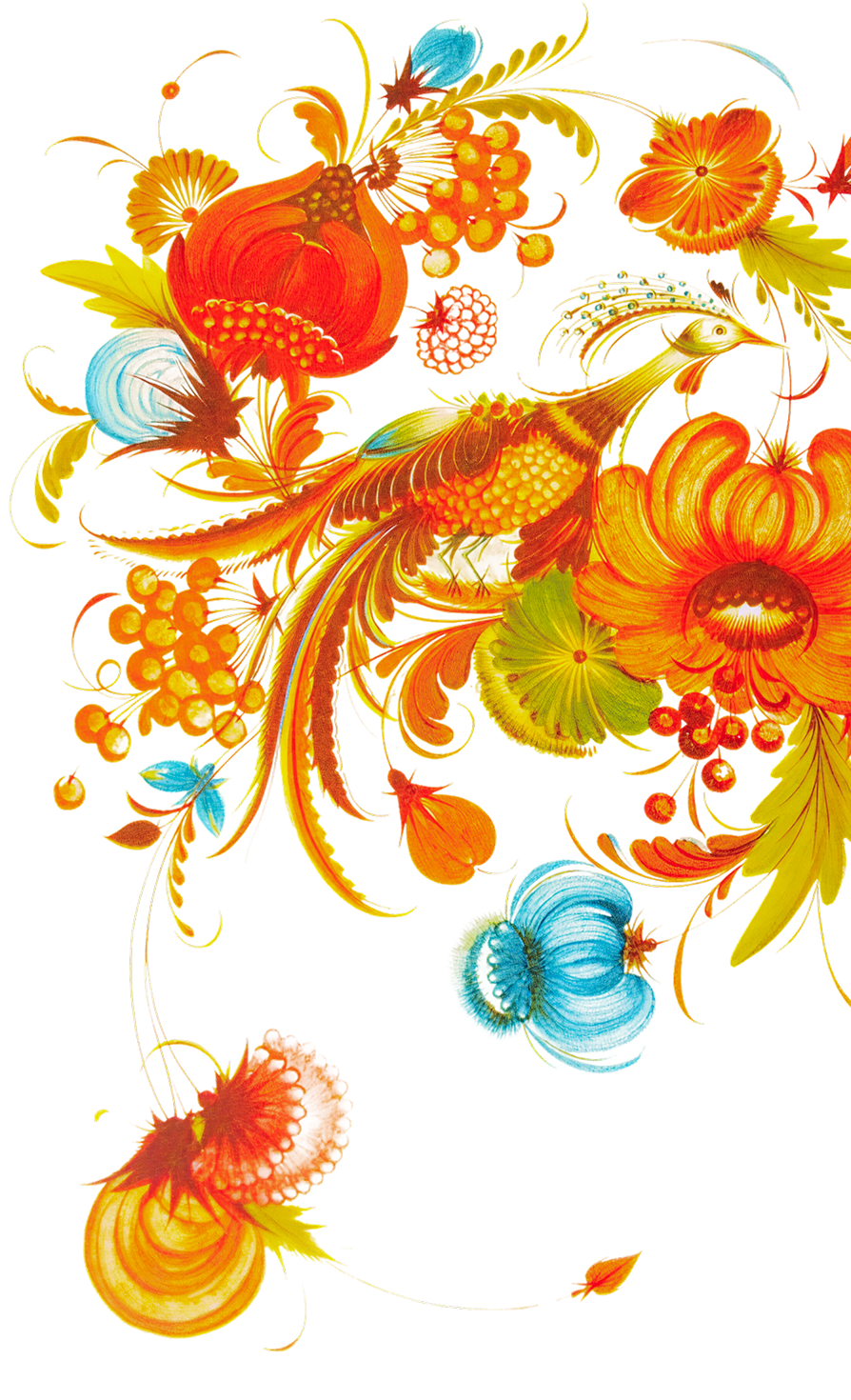
The Art of Free People
Petrykivka was founded as a free Cossack settlement — serfdom was never known here. According to researchers, this very freedom was the main reason for the flourishing of a unique folk art — Petrykivka painting.
Ten short facts about one of the brightest phenomena of Ukrainian folk art — plus a bonus presentation you can share.
Petrykivka was founded as a free Cossack settlement — serfdom was never known here. According to researchers, this very freedom was the main reason for the flourishing of a unique folk art — Petrykivka painting.
Petrykivka painting originated as a sacred interior decoration, adorning stoves, windows, and walls. Later, it moved to paper so that even those who couldn't paint themselves could still decorate their homes. This is how modern Petrykivka painting came to be.
Petrykivka masters handcraft their brushes from cat hair. Such a brush allows painting thin lines and creating the characteristic elements found only in Petrykivka painting. No cat was harmed — before trimming, the cat is treated to milk or sour cream.
Viburnum berries are traditionally painted with a finger — so that the imprint of the master's hand remains visible. Fingers are also used to create various flowers, leaves, fruits, and berries. Vasyl Sokolenko, for example, created his works using only a cat-hair brush and his own fingers.
In 1911–1913, artist Yevheniia Evenbakh, commissioned by academician Dmytro Yavornytskyi, made copies of wall paintings from Petrykivka cottages. This is how the first examples reached museums and were documented. Earlier examples have not survived.
Tetiana Pata, Nadiia Bilokin, Paraska Pavlenko, and Oryna Pylypenko inherited the art of house painting from their mothers and became the foundation for the revival of Petrykivka painting in the early 1930s. Their style is also known as the 'source' style.
The school was founded on the initiative of Oleksandr Statyva, an art historian and local teacher. Tetiana Pata became its first painting instructor. The school produced several generations of renowned masters — Fedir Panko, Vasyl Sokolenko, Marfa Tymchenko, and others.
Petrykivka painting on black backgrounds appeared in the 1950s — it was introduced at the Druzhba factory for the mass production of souvenirs. Traditionally, the painting is executed on a white background.
On December 5, 2013, Petrykivka painting became the first Ukrainian element inscribed on UNESCO's Representative List of the Intangible Cultural Heritage of Humanity.
Petrykivka painting is alive and thriving today: the Center of Folk Art and the Tetiana Pata School operate in Petrykivka, studios and children's clubs are active across Ukraine, and exhibitions and masterclasses are held regularly around the world.
We've gathered all these facts into a handy Google Slides presentation. Download it, share with friends, use it in classrooms and lectures — Petrykivka painting deserves to be known.
Open presentation