Biography
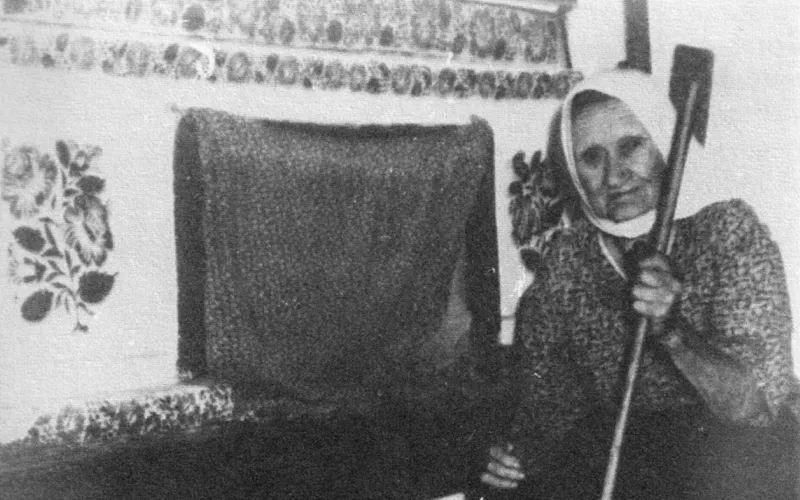
Paraska Mykolaivna Pavlenko was born on January 19, 1881, in Petrykivka—the oldest known master of Petrykivka painting. She was taught to paint by her mother from the age of six: her mother decorated the stove chimneys and the walls of their house with flowers, and these floral paintings were intentionally not whitewashed over—they remained on the walls for two or three years.
Painting in the Pavlenko family was a shared activity. In the 1920s, when Paraska Mykolaivna made decorative “strips” for the stove, she painted green leaves and stems; her elder daughter Vira added red flowers; the younger daughter Halya “filled in” blue grape berries; and three-year-old Vasylko laid the finished strips on the stove ledge to dry. In this way, the art was passed down not through words but through hands—in a living, collective practice.
Both daughters became renowned мастers: Vira Pavlenko (1912–1991) and Halyna Pavlenko-Chernychenko (1919–2008) moved to Kyiv, where they developed the traditions of Petrykivka painting on porcelain at the Kyiv Experimental Ceramic and Art Factory.
Paraska Mykolaivna lived for over one hundred years and died in 1983.
Art
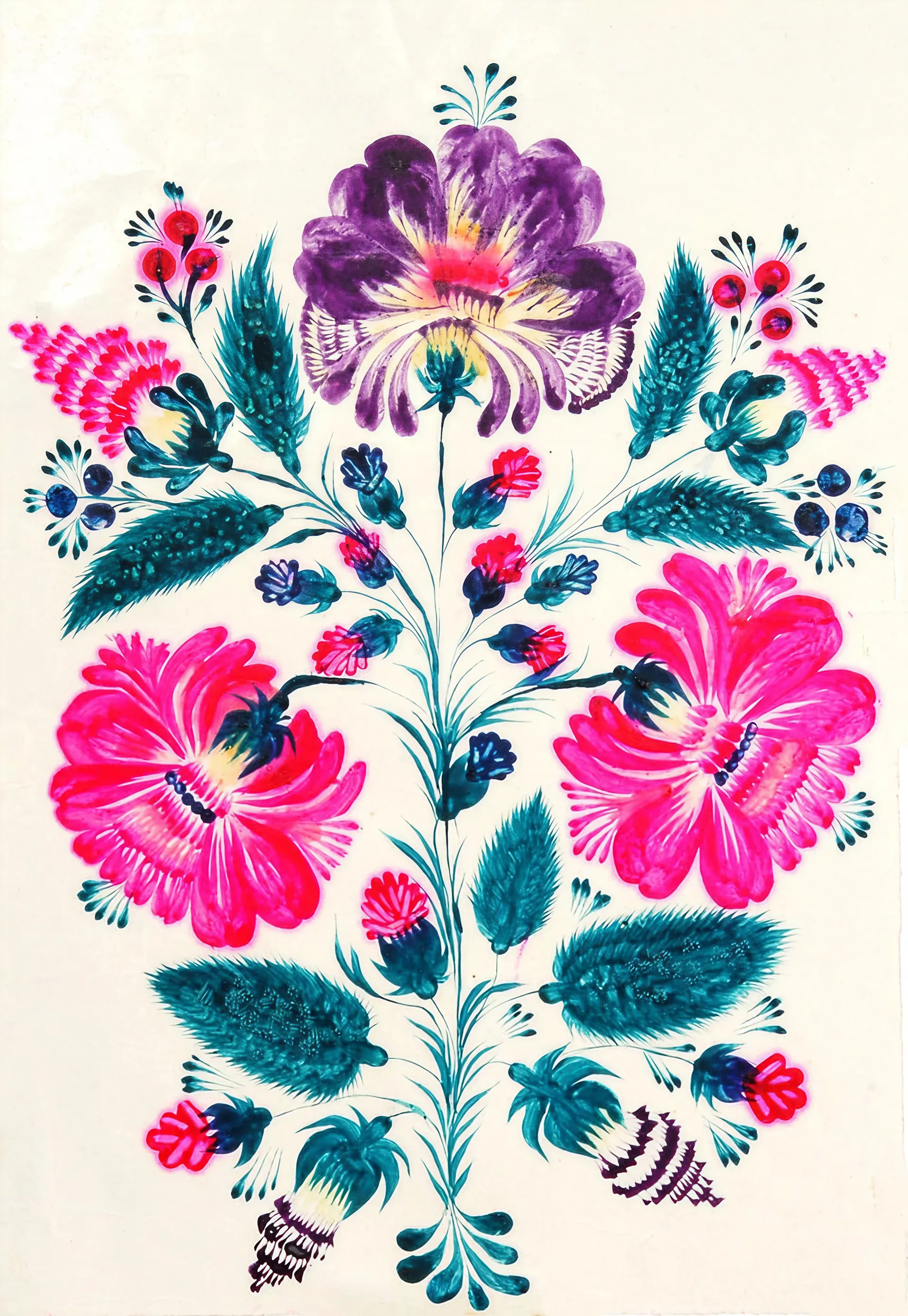
Paraska Pavlenko’s works preserve more than any others the qualities of traditional wall painting—she never departed from its original sources. Plant motifs flow easily across the white surface of the paper; tonal areas are balanced, the color palette is harmonious, and the drawing is light and virtuosic.
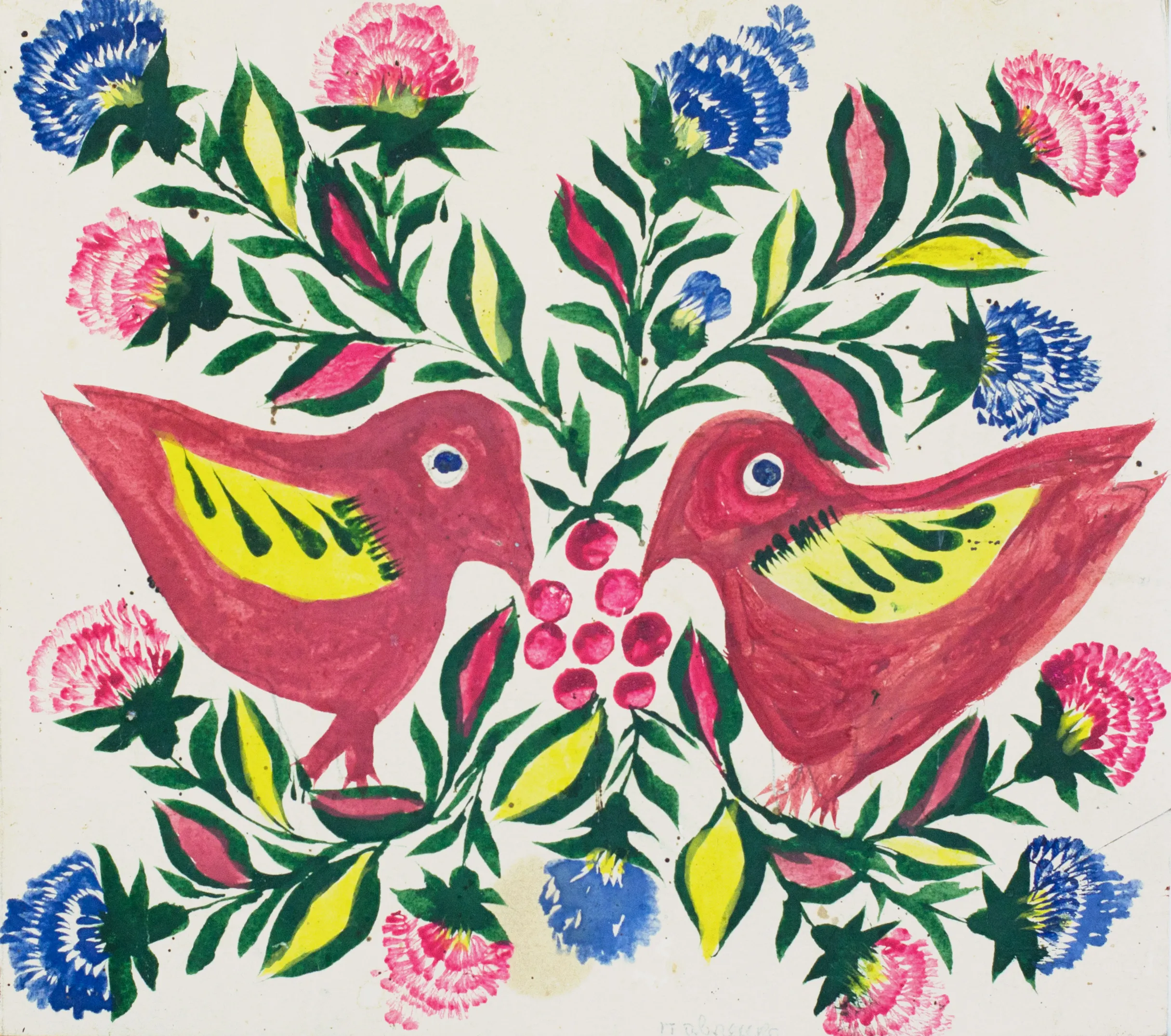
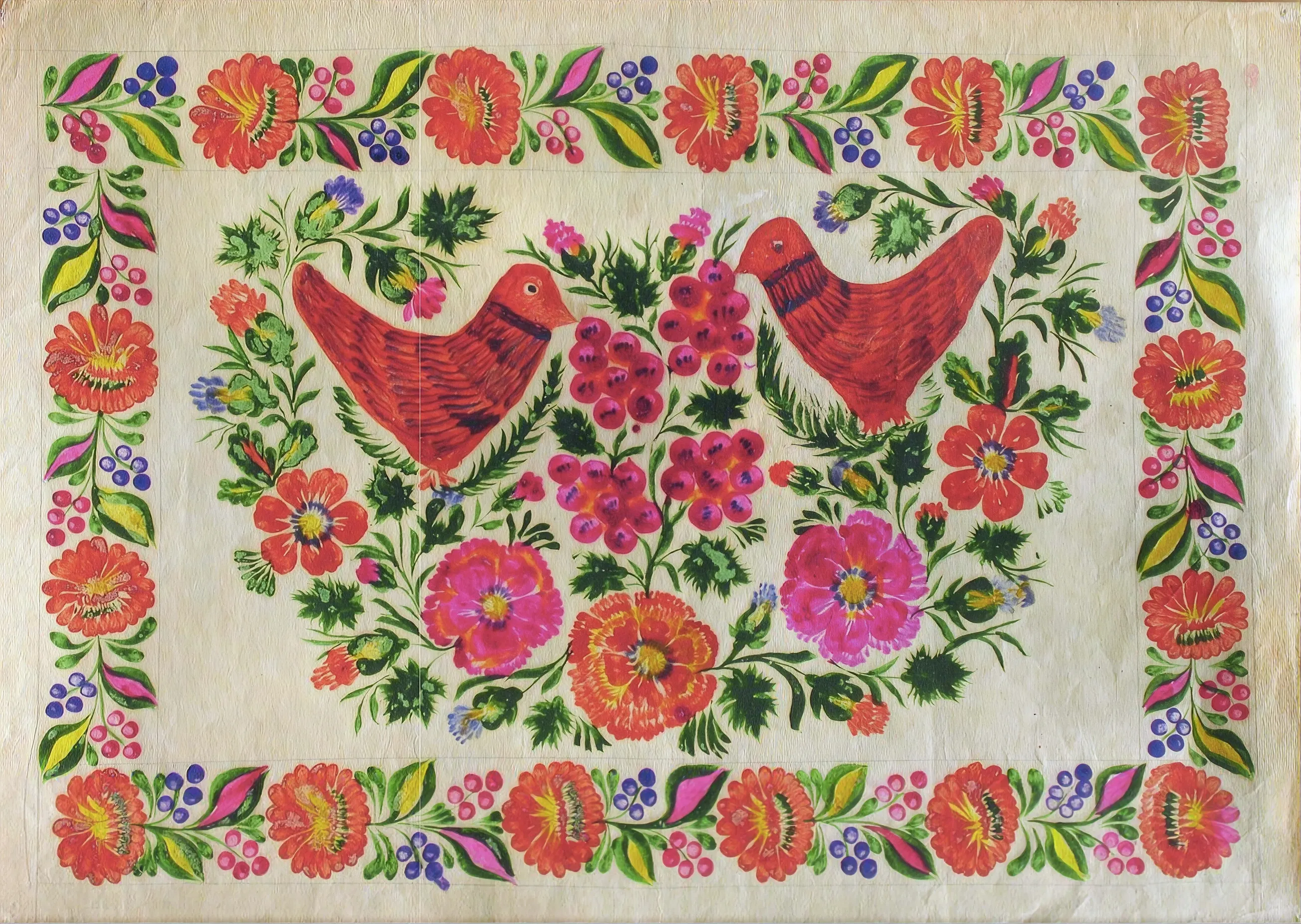
Her favorite subjects were birds and flowers. Her birds are always simplified, without excessive detail, filled in with solid color; when depicted in pairs, they face one another, as if pecking at berries. She composes flowers around a central—always round—large bloom, without connecting the elements by shared stems: unity arises from placement rather than from line.
Her brushstrokes are not laid densely—white background always shows through between them, giving the paintings a lace-like transparency and lightness. She used only five pure aniline colors—red, crimson, blue, green, and yellow—and never mixed them. Yellow plays a supporting role: it connects the elements and softens the contrasts between the warm red and the cool green and blue.
Among her known works are: “Decorative Motif” (1964), “Frieze” (1964), “Bouquet of Flowers in a Vase” (1980), and “Rug” (1980).
Recognition
She participated in exhibitions of folk art. She was the matriarch of an entire artistic dynasty—her daughters Vira Pavlenko and Halyna Pavlenko-Chernychenko became Honored Masters of Folk Art of the Ukrainian SSR. Her works are held in private collections, including those of Andrii Pikush and Volodymyr Padun; pieces from these collections were included in the illustrated catalogue published in 2014.