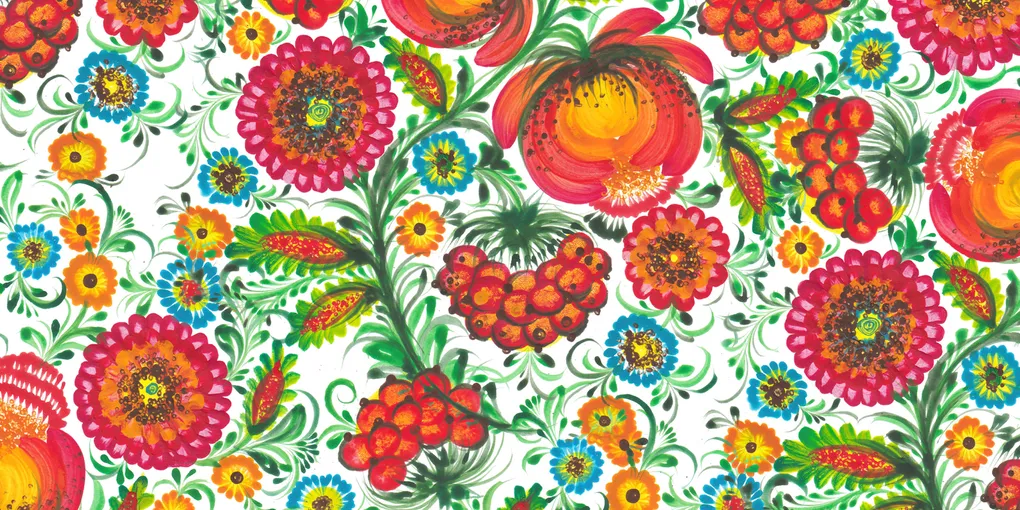
What Is Petrykivka Painting? A Complete Guide
Petrykivka painting is a traditional Ukrainian decorative-ornamental folk art that originated in the village of Petrykivka, Dnipropetrovsk region. Historically dating back to at least the 18th century, it has become a globally recognized hallmark of Ukrainian culture and was inscribed on the UNESCO Representative List of the Intangible Cultural Heritage of Humanity in 2013.
History and Origins
The tradition began with settlers decorating their white-washed clay huts with vibrant floral murals to protect their homes from sorrow and evil. While some contemporary artists trace its aesthetic roots back to the prehistoric Trypillian culture, the style flourished as a distinct craft practiced primarily by village women known as chepurushky.
In the early 20th century, ethnographer Dmytro Yavornytsky brought international attention to the style by documenting murals and organizing its first exhibitions. During the Soviet era, the art was institutionalized through the Druzhba factory (1956–2006) for mass production, though this period also introduced non-traditional elements like black backgrounds influenced by Russian styles.
Unique Technique and Tools
Petrykivka is defined by its two-dimensional perspective, lack of realistic depth, and vibrant color palettes.
- The Kotyachka (cat-hair brush): handmade from the hair of domestic cats, these brushes are exceptionally elastic, allowing for both thick lines and “weightless,” airy details.
- Finger painting: artists often use their fingers to paint berries, resulting in a distinct round shape with a light center and dark edges.
- The four basic strokes: mastery of the style involves four specific strokes — the hrebinets (comb), zerniatko (seed), horishok (nut), and the perekhidnyi mazok (transitional stroke), which creates a gradient by dipping one brush into two different colors.
Symbolism and Imagery
The imagery in Petrykivka is rich with spiritual meaning and often depicts imaginary flora and fauna rather than realistic species.
- Tsybulka (little onion) — a cornerstone floral element resembling a cut onion bulb.
- Bihunets (runner) — a continuous floral frame symbolizing eternity and the rhythmic cycles of nature.
- Fauna symbols: the rooster represents fire and spiritual awakening; birds generally symbolize light and harmony; the mythical firebird is a symbol of happiness.
- Flora symbols: red viburnum (kalyna) berries stand for femininity and the continuity of the kin, while the oak represents the sun.
Legendary Masters
The continuity of the tradition is maintained through generational schools and dynasties.
- Tetiana Pata — often considered the founder of the professional school; taught the first generation of masters in the 1930s.
- Nadia Bilokin — a pioneer known for her scenes of village life and decorative panels.
- Fedir Panko and Vasyl Sokolenko — influential figures who revived wood painting and established experimental workshops to preserve individual creativity against industrial mass production.
- Modern leaders — contemporary masters include Andriy Pikush, Halyna Nazarenko, Valentyna Panko, and Natalia Rybak.
Modern Application and Recognition
Today, Petrykivka has evolved into a versatile modern art form used in interior design, fashion (T-shirts, backpacks), and digital art. It serves as a tool for cultural diplomacy and resilience: patterns are now painted on war artifacts and used in art therapy for soldiers. Beyond the village, its influence has reached global stages, including Eurovision 2017 logo proposals and the Burning Man 2019 “Catharsis” installation.