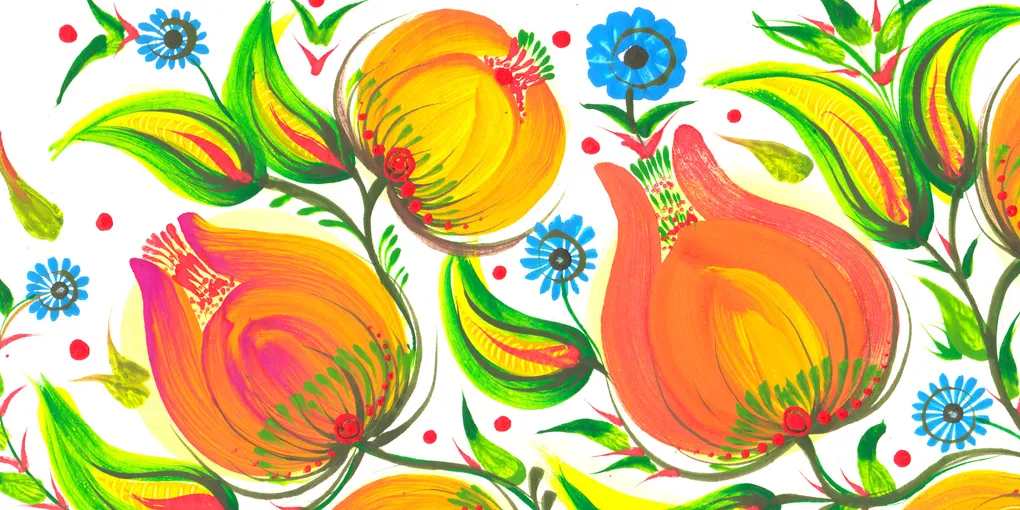
Symbolism in Petrykivka Painting
Petrykivka painting is a vibrant language of symbols that transcends mere decoration; it is traditionally viewed as a spiritual talisman (oberih) intended to protect people from sorrow, evil, and misfortune. The art form is defined by an absolute philosophy of positivity, never depicting scenes of sorrow, war or hardship — only happiness, love and the “paradise-like” beauty of the natural world.
Floral and Plant Symbolism
At the heart of Petrykivka are floral motifs, often depicting “fantastic” or imaginary flowers that do not necessarily correspond to real species, representing the highest manifestation of beauty and a perfect Earth.
- Tsybulka (little onion) — a cornerstone of the style, named for its resemblance to an onion bulb cut in half.
- Kucheriavka (curly flower) — characterized by twisted, “curly” tufts that add texture and fantasy to compositions.
- Viburnum (kalyna) and mallow — iconic symbols of femininity and maiden beauty. The viburnum berries, often painted with the artist’s finger, specifically represent the continuity of the kin.
- Oak — a symbol of the sun and masculine strength.
- Fantasy composites — patterns often combine real flowers like dahlias, asters and roses into imaginary plant and shrub arrangements.
Fauna and Mythological Creatures
Animals and birds are central figures, often depicted in profile to signify light, harmony and happiness.
- Rooster — a powerful symbol of fire, spiritual awakening and the rebirth of the soul.
- Firebird (Phoenix) — a mythological creature from Slavic folklore with glowing feathers, representing happiness and resilience — rising from the ashes like a new soul.
- Cuckoo — signifies the mystery of life and the endless flow of time.
- Birds in pairs — often represent love and the creation of a family.
Human and National Symbols
- Cossack Mamai — a legendary figure representing national pride, bravery and resilience. He is often shown as a warrior with his sword down, smoking a pipe and playing the kobza, symbolizing strength tempered with sensitivity. Contemporary beliefs suggest his image can protect soldiers from casualties.
- The Berehynia — a female spirit often included in modern works to act as a protectress of the home and a “hearth mother.”
Compositional Symbolism
- Bihunets (the runner) — this continuous rhythmic floral frame symbolizes eternity and the cyclic nature of existence, reflecting the change of seasons or the succession of life and death.
- Cosmic laws. Many masters believe Petrykivka symbols represent fundamental laws of life and cosmic evolution, predating formal scientific understanding.
- Nature-centric philosophy. The compositions place nature at the center, reminding viewers that humans are merely one part of a larger, harmonious world — like a single petal or bee.
In modern contexts, these protective symbols have been adapted to current realities, appearing as cultural diplomacy or even as protective art on military artifacts like shells and helmets to provide a sense of hope and stability.