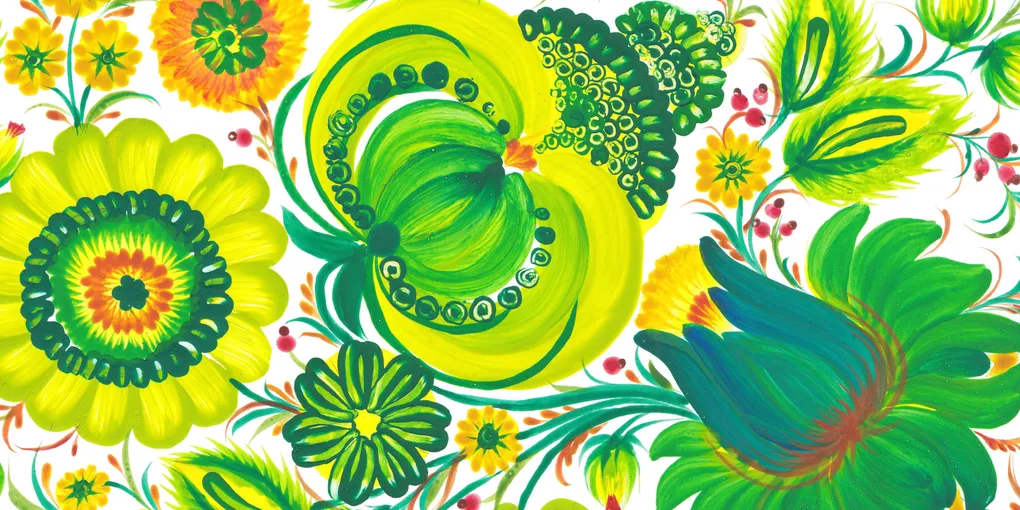
Petrykivka's Place in Ukrainian Culture
Petrykivka painting occupies a central role in Ukrainian culture as both a traditional folk craft and a powerful modern symbol of national identity, spiritual resilience, and the spirit of freedom. Originally used to decorate whitewashed village huts in eastern Ukraine, it has evolved into a globally recognized “brand” of Ukrainian heritage, protected by UNESCO.
A Symbol of Freedom and Independence
A defining aspect of Petrykivka’s place in Ukrainian culture is its historical connection to the spirit of freedom. The village of Petrykivka was founded in 1772 as a settlement for Zaporozhian Cossacks and never knew serfdom. Local artists and historians argue that this lack of enslavement allowed the art form to flourish as an expression of personal dignity and political independence, which is reflected in the “free” and airy nature of its brushstrokes.
Spiritual Protection and the Oberih
Historically, Petrykivka was not merely decorative but functional, serving as a spiritual talisman (oberih).
- Protection from evil. Villagers believed that painting colorful flowers around doors and windows protected the home and family from sorrow, bad luck and evil spirits.
- Symbolic language. The art carries a deep “cosmic meaning” that predates scientific understanding, illustrating a philosophy where humans are part of a harmonious natural world.
- Key motifs. Every element has a spiritual meaning: the rooster stands for spiritual awakening and the rebirth of the soul; birds represent light and harmony; viburnum berries symbolize femininity and the continuity of the kin.
Resilience Against Cultural Unification
The role of Petrykivka has often been a battleground for cultural identity, particularly during the Soviet era.
- Soviet industrialization. During the mid-20th century, the Druzhba factory mass-produced souvenirs, often introducing elements alien to the tradition, such as black backgrounds intended to make Petrykivka look more like Russian folk styles (Zhostovo or Khokhloma).
- Reclaiming the heritage. In response, masters like Fedir Panko founded experimental workshops to return to the art’s “true” roots — handcrafted pieces on light backgrounds. Since the collapse of the USSR, there has been a powerful movement of “cleansing” to remove these external influences and re-establish Petrykivka as an inherently Ukrainian folk art.
UNESCO Status and National Pride
In 2013, Petrykivka became the first Ukrainian cultural phenomenon to be inscribed on the UNESCO Representative List of the Intangible Cultural Heritage of Humanity. This recognition was a milestone for national pride, serving as a tool to mark Ukraine’s cultural and geographical borders on the international stage.
Contemporary Life and Cultural Diplomacy
Today, Petrykivka is a vibrant “living heritage” that continues to adapt to modern Ukrainian life.
- Modern branding. It appears on diverse media, from bank cards and digital art to backpacks, T-shirts and even tattoos, allowing people to publicly display their Ukrainian identity.
- Cultural diplomacy. Artists like Halyna Nazarenko use exhibitions abroad as a form of cultural diplomacy, building a positive image of Ukraine through art rather than just political events.
- Symbol of wartime resilience. Since the 2014 invasion and the 2022 full-scale war, the protective quality of Petrykivka has been recontextualized. Artists paint Cossack Mamai or floral patterns on military artifacts like shells and helmets, and the art is used in therapy programs for soldiers and displaced persons to provide a sense of stability and hope.