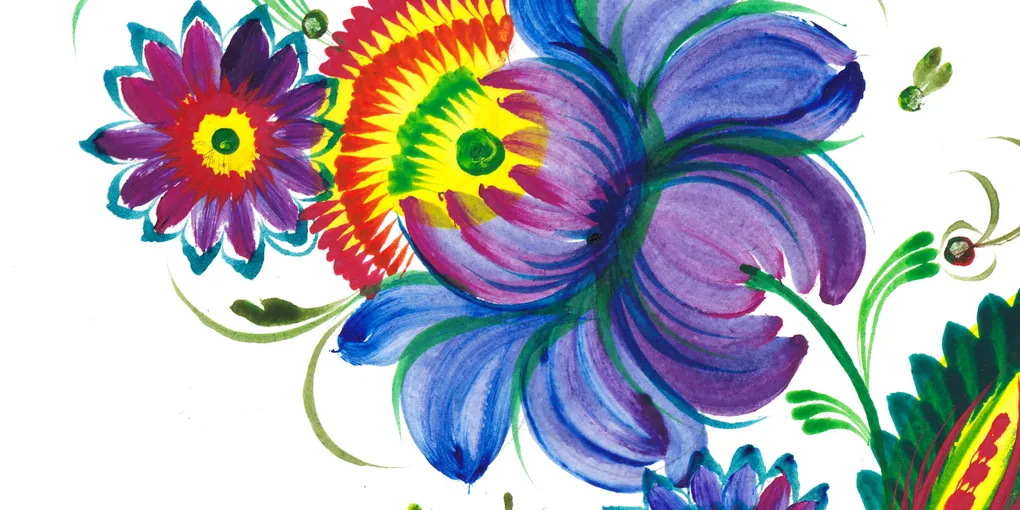
Petrykivka vs Other Folk Art Traditions
Petrykivka painting is distinguished from other world folk art traditions by its specific historical environment, unique handmade tools, and a philosophy that focuses exclusively on positive imagery. While it shares roots with other decorative styles, its development as a symbol of “freedom” and its resistance to external stylistic impositions make it a unique phenomenon in Ukrainian and global heritage.
Contrast with Russian Folk Art (Khokhloma, Zhostovo, Gzhel)
During the Soviet era, Petrykivka was often compared to — and pressured to emulate — Russian folk traditions like Khokhloma, Zhostovo, and Gzhel.
- Background color. Traditionally, Petrykivka was painted on white backgrounds (whitewashed walls or white paper). In the 1960s, Soviet authorities introduced a black background to make it more commercially similar to Russian Zhostovo and Khokhloma styles. Contemporary masters have worked to “cleanse” the art of this influence, returning to the traditional light or natural wood backgrounds.
- Stroke technique. Masters note that while Russian styles like Gzhel often feature “pompous curves” that can appear machine-like, Petrykivka is defined by an “orchestra of lines” that are weightless and airy.
- Industrialization vs. improvisation. While Russian styles were heavily industrialized early on, Petrykivka artists resisted the “conveyor belt” approach, forming experimental workshops in the 1970s to maintain individual creativity and high-quality handcrafted pieces.
Comparison with Other Ukrainian Regional Traditions
Mural decoration was common throughout many regions of Ukraine, including Podillia, Sloboda, and the Uman regions.
- Origin excellence. While many villages practiced floral mural painting, Petrykivka became the “home” of the tradition because it was a significant economic trading hub and established a dedicated school of decorative art as early as 1935.
- Historical context. Unlike many other regions, the people of Petrykivka never knew serfdom. This lack of enslavement is credited with fostering a “spirit of freedom” that permeated their art, allowing it to develop as a free-form, imaginative expression of self-dignity.
Unique Tools and Technical Mastery
Petrykivka is world-renowned for its use of specialized, natural tools that are not typically found in other folk traditions:
- The Kotyachka. While other traditions use squirrel or ferret fur, Petrykivka’s most valuable tool is a brush made from cat hair (specifically from the neck or under the paw). This brush is uniquely elastic, allowing for the incredibly thin lines known as petushynnia (feathering).
- Finger painting. Unlike styles that rely strictly on brushes, Petrykivka uses the human finger as a primary tool to create berries and flower centers, leaving a distinct print that is light in the center and dark at the edges.
Philosophical and Symbolic Differentiators
- Fantastic vs. realistic. Unlike some folk arts that attempt to depict real-world species, Petrykivka flowers are entirely fantastic and have no analogues in real nature. They are products of the artist’s imagination, transformed into “paradise gardens.”
- The “vitamin” of joy. Petrykivka is uniquely defined by its absolute lack of negativity. It never depicts scenes of sorrow, war or hardship; its purpose is strictly to be “pleasing to the eye and make souls happy.”
- Protective function. Traditionally, these paintings were considered spiritual talismans (oberihy), applied to the entrances of homes to protect the family from evil spirits and misfortune.
In 2013, this distinctiveness was officially recognized when Petrykivka became the first cultural phenomenon from Ukraine to be inscribed on the UNESCO Representative List of the Intangible Cultural Heritage of Humanity.