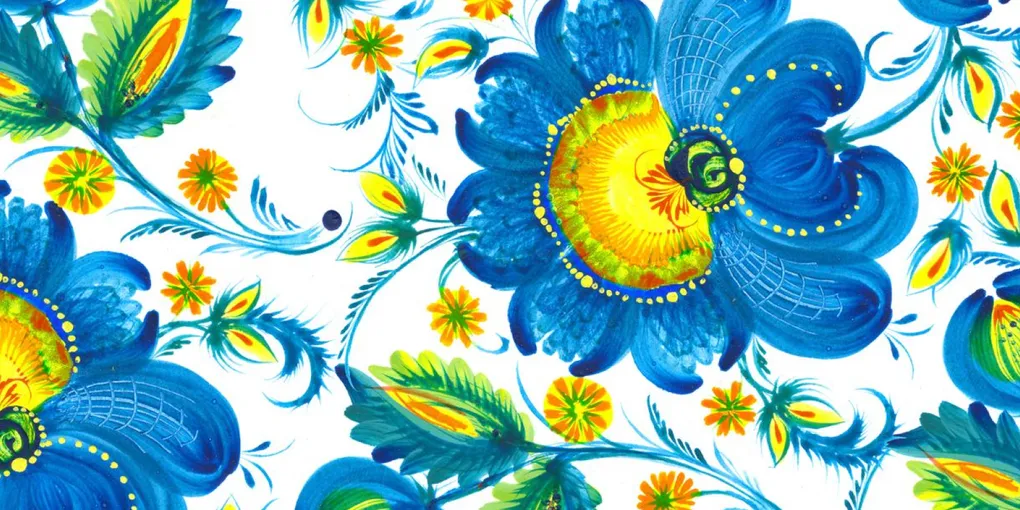
Beginner's Guide to Petrykivka Painting
This beginner’s guide introduces the essential techniques, tools and philosophy of Petrykivka painting, a traditional Ukrainian decorative style originating in the 18th century from the village of Petrykivka. Inscribed on the UNESCO Representative List of the Intangible Cultural Heritage of Humanity in 2013, this art form is characterized by its vibrant colors and fantastic floral imagery.
The Philosophy of Petrykivka
For a beginner, it is important to understand that Petrykivka is more than just decoration — it is a spiritual talisman. Traditionally, these patterns were painted on the walls of houses to protect the family from sorrow and evil. A unique aspect of its history is that the people of Petrykivka never knew serfdom, and artists believe this “spirit of freedom” and independence is reflected in the airy, improvisational nature of the strokes. Furthermore, Petrykivka never depicts scenes of sorrow or hardship — it is an art of absolute positivity intended to make souls happy.
Essential Tools and Materials
The tools of Petrykivka are largely of natural origin and often handmade by the artists themselves.
- The Kotyachka (cat-hair brush). This is the most vital tool, crafted from small tufts of hair taken from a common domestic cat (usually from under the paw or the neck). Cat hair is exceptionally elastic, allowing artists to create incredibly thin, “weightless” lines known as petushynnia.
- Finger painting. Beginners often start by using their own fingers. Dipping the index finger into paint and pressing it onto the surface creates perfect circles for berries (like kalyna), which are light in the center and dark at the edges.
- Paints. Historically, pigments were extracted from natural juices — such as cherry for red or snowdrops for blue — and mixed with egg yolk or milk. Today, most beginners use gouache or watercolor on a white or light background.
The Four Fundamental Strokes
Mastering Petrykivka begins with learning four specific brush strokes that serve as the “alphabet” of the style.
- Hrebinets (comb) — starts with heavy pressure to create a thick base and ends with a light, thin, whisker-like tip.
- Zerniatko (seed) — the reverse of the comb stroke: starts with a light touch and ends with heavy pressure, looking like a grain of wheat when placed along a stem.
- Horishok (nut) — two curved hrebinets strokes are placed opposite each other, and the space between them is filled with a zerniatko, creating a shape like a hazelnut.
- Perekhidnyi mazok (transitional stroke) — used to create a color gradient without pre-mixing paints. A dry brush is dipped into one color (e.g. green) and then just the tip is dipped into a second color (e.g. yellow). The resulting stroke transitions smoothly from one color to another.
Core Imagery and Symbolism
Petrykivka features a “fantasy world” of imaginary flora and fauna.
- Tsybulka (little onion) — an imaginary flower named for its resemblance to a half-onion bulb; a foundational element of the style.
- Kucheryavka (curly flower) — a flower characterized by twisted, curly tufts at its top.
- Bihunets (runner) — a rhythmic floral frame or border that symbolizes eternity and the cycles of life and death.
- Fauna — the rooster represents spiritual awakening and fire, while the mythical firebird is a symbol of happiness.
Compositional Rules
When starting your first piece, keep in mind that Petrykivka is strictly two-dimensional. There is no realistic perspective or overlap of stems. Most elements are built around a central stem, with flowers shown head-on and birds or animals shown in profile. Experienced masters often paint “by eye” without sketches, but beginners are encouraged to plan their layout mentally before applying the paint.